
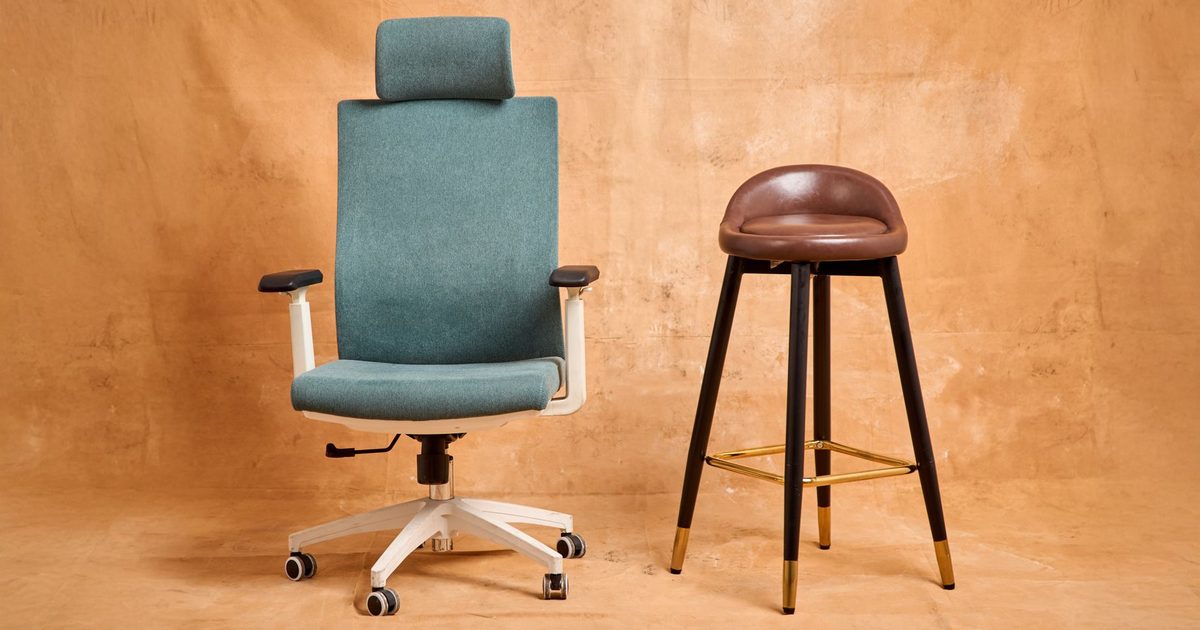
Two people with the same budget can want opposite things from a work chair. One wants mesh, to stay cool through the day; the other wants padding, to sink into something soft the moment they sit. Neither is wrong, and it is that fork, not the badge on the backrest, that this guide sorts out. Mesh lets air through, so it does not hold the warmth of the room; foam and a padded seat feel softer at once, and they are kinder if you tend to perch on the edge rather than settle right back. So the three chairs here are not first, second and third: they answer three different sitters, a fully adjustable mesh chair for the person at the desk all day, a compact one that gets out from underfoot in a small room, and a padded chair for anyone who never took to mesh. Work out which of those three is you, and the rest of this guide falls into place.
Which sitter are you?
1. SIHOO M57 Ergonomic Mesh Office Chair - Best Overall
HSP Score: 9.5 / 10 - The most adjustable chair here, and the one that stays coolest.
Capability 9.8/10 - Versatility 9.4/10 - Build 8.9/10 - Value 8.9/10 - Fit 9.8/10
Fit for this guide: The most adjustable chair here and the airiest over a long day: the headrest, arms, lumbar and recline all move to suit you.
What keeps it off a 10: At this price you get the adjustments but not the decade-long warranty or the replaceable gas cylinder of a chair several times the money.
Every pick here is scored out of 10: four marks rate the product and are the same in every guide, and the fifth rates its fit for this guide - how we test and score.
If you sit at the same desk for a full working day, this is the one to reach for. The M57 is a full-mesh chair, so the back and seat let air through instead of trapping it, and almost everything on it moves. The armrests adjust in three planes, up and down, forward and back, and pivoting inward. The lumbar support slides both up and down and in and out, so you set where it meets your back rather than accepting a fixed pad at whatever height the factory chose. There is an adjustable headrest on top, and the back reclines from upright to about 126 degrees, so you can sit forward to type and tip back to read or take a call. It carries all of that on a reinforced aluminium base rated to 150 kg. The catch at this price is not the chair itself but what it cannot include: a warranty measured in years rather than a decade, and a gas cylinder you would replace rather than the whole chair. For a chair you will be in from nine to five, the range of adjustment is worth more than the badge.
Pros
- ✓ Arms, lumbar, headrest and recline all adjust, so it fits a range of sitters rather than one
- ✓ Full-mesh back and seat let air through, which keeps it cooler than foam across a long day
Cons
- ✗ A mesh seat feels firmer at first sit than a padded one, which not everyone likes
- ✗ Assembly takes longer than the simpler chairs here because there are more parts to fit
Who it's for: Anyone at a desk for a full working day who wants to set the chair to themselves rather than the other way round.
Who it's not for: Skip it if mesh feels too firm underneath, or if you want a chair built in five minutes.
2. SONGMICS Office Chair OBN37BKUK - Best for a Small Room
HSP Score: 8.9 / 10 - A compact mesh chair with flip-up arms that tucks away.
Capability 8.9/10 - Versatility 8.5/10 - Build 8.5/10 - Value 8.5/10 - Fit 9.4/10
Fit for this guide: Flip-up armrests and a compact frame let it slide right under a desk, freeing the floor in a tight room.
In a spare-room office or a corner of the bedroom, the chair's footprint matters as much as the chair. The OBN37BKUK is a smaller mesh chair whose armrests flip up out of the way, which is the trick that lets it slide right under the desk when you stand up instead of sitting half out in the room and blocking the path to the window. It has a mesh back for the same airflow reason as the pick above, an adjustable lumbar cushion you can set to your back, and a rocking function if you want to tip back between tasks. The seat is 53 cm across, which is generous for the chair's size but still narrow enough not to swamp a small desk. What you give up against the M57 is the depth of adjustment: the lumbar is a positionable cushion rather than a support that moves in every direction, and there is no headrest. For a tight room, or a chair that has to share its space with the rest of a bedroom, that trade is an easy one to make.
Pros
- ✓ Flip-up armrests let it tuck right under the desk, which frees the floor in a small room
- ✓ A mesh back and a 53 cm seat give a full-size feel without a full-size footprint
Cons
- ✗ The lumbar is an adjustable cushion rather than a support that moves in and out as well
- ✗ No headrest, so a taller sitter who likes to rest their head back will want the M57
Who it's for: Anyone in a small or shared room who needs the chair to disappear under the desk when it is not in use.
Who it's not for: Anyone who wants the fullest set of adjustments and has the floor space for a larger chair.
3. SONGMICS Executive Office Chair OBG22BUK - Best Padded Chair
HSP Score: 8.3 / 10 - A padded high-back chair for anyone who dislikes mesh.
Capability 8.0/10 - Versatility 7.6/10 - Build 8.0/10 - Value 8.5/10 - Fit 8.9/10
Fit for this guide: The pick for anyone who finds mesh too firm: a padded PU seat and high back that feel soft from the first sit.
Some people sit down on a mesh seat, decide it feels like a trampoline, and never warm to it. If that is you, this is the chair. The OBG22BUK is a padded high-back chair finished in PU leather over high-density foam, so the seat and back give underneath you the moment you sit rather than pushing back the way a taut mesh panel does. The back runs high, the height adjusts on the usual gas lift, and it is rated to 150 kg. The two honest trade-offs are airflow and adjustment. A padded PU seat runs warmer than mesh over a long afternoon, especially in a warm room, and the back is a fixed shape rather than a support you dial in like the two mesh chairs above. In return you get the softer, sink-in feel that a lot of people simply prefer, and a look that suits a room where the chair is on show rather than hidden under a desk.
Pros
- ✓ A padded PU seat and back feel soft from the first sit, with none of the firmness of mesh
- ✓ A high back, on a frame rated to 150 kg
Cons
- ✗ PU over foam runs warmer than mesh the longer you sit, which tells in a warm room
- ✗ The padded back is a fixed shape rather than an adjustable support you set to yourself
Who it's for: Anyone who prefers a soft, padded seat and a high back, and does not get on with mesh.
Who it's not for: Skip it if you run warm, or if you would rather fine-tune the back than accept a fixed shape.
Quick verdict
Most people should just buy the SIHOO M57 Ergonomic Mesh Office Chair: its arms, lumbar, headrest and recline all move, so the chair bends to fit you and not the reverse. Short on floor space? The SONGMICS Office Chair OBN37BKUK folds its arms up and vanishes under the desk. Not sold on a mesh seat? The SONGMICS Executive Office Chair OBG22BUK swaps it for a padded PU high-back that gives the moment you sit.
Mesh or padded: settle this first
This is the fork the whole choice turns on, so answer it before you compare anything else. Mesh is a panel of tensioned fabric, so it lets air pass straight through and stays closer to room temperature through a long session; it also pushes back a little, which some people read as support and others read as firm. Padding is foam under fabric or PU, so it gives when you sit and feels softer at once, at the cost of holding warmth against you over time. There is one detail the listings blur that is worth checking: plenty of chairs sold as mesh have a mesh back over a foam seat, which is a different thing from an all-mesh chair like the M57. If the seat is what you care about keeping cool, read the description for what the seat itself is made of, not just the back. Neither material is the right answer on its own; the right answer is the one that matches how warm you run and whether you like to sit into a chair or on top of one.
The chair has to fit the desk and the room
A chair that suits you can still be wrong for the space, so measure the room as well as yourself. The figure that catches people out is the footprint when the chair is pushed back and not in use: a wide chair with fixed arms sits out in the room and can block the route past the desk, which is exactly the problem the flip-up arms on the compact pick solve by letting it slide under. Check the seat height range against your desk too, because a chair set too high leaves your feet dangling and your forearms reaching down, and if the chair cannot come down far enough a footrest is the usual fix. Armrests are the other clearance question: arms that do not drop or fold can stop a chair tucking under a desk with a low apron or a keyboard tray, and our guide on whether a chair needs armrests runs that desk-edge check in full. Once the chair and desk are sorted, the last piece is the screen, and our guide on how high your monitor should be covers setting it to your eye line from where you now sit. A hard floor is one more thing to check: the wheels a chair arrives on are usually the carpet type, and our guide to which casters are safe for hard floors covers the soft-tread swap that protects a wood or laminate surface. If you are still choosing the desk itself, the standing desk guide is the companion to this one.
What actually adjusts, and in what order
Listings sell chairs on the number of adjustments, but the count matters less than which ones you get, so here is the order they earn their place. Seat height comes first, because a seat at the wrong height throws off everything above it, and every chair here adjusts it; our guide to what height a chair should be follows the HSE's own order for setting it. Armrest height is next: arms at the right height give your forearms somewhere to rest, and arms that also fold or drop decide whether the chair tucks away. After that comes the lumbar, and this is where the chairs separate, because a support that slides up and down and in and out (as on the M57) can be set to your back, while a fixed pad or a cushion at one height is a take-it-or-leave-it affair. Tilt and recline come next, useful for shifting position through the day rather than sitting locked upright. Seat depth adjustment is the rarest at this price and the one most people can live without. Read a spec sheet in that order and a long list of features sorts quickly into the ones that will change how the chair feels and the ones that just fill a bullet list.
What this budget buys, and what it does not
It is worth being straight about the ceiling of this price band. At this budget you can buy a chair that adjusts well, sits on a solid base and lasts a good while, and the M57 is proof of how much adjustment the money now stretches to. What you cannot buy at this price is the pair of things that separate these chairs from the ones that cost four times as much: a warranty measured in more than a decade, and parts like the gas cylinder or the mechanism sold separately so you repair the chair rather than replace it. The gas cylinder is the one part that bucks this, a near-universal fitting you can buy and swap yourself whatever the chair cost if a seat ever starts to sink, and our guide to gas lift class explains which one to pick. A chair at this price is a chair you expect to get several good years from, not one you pass down. Two practical points go with that. A chair is a bulky item to send back if it does not suit you, so it is worth deciding on mesh or padded before it arrives rather than after. And all three here are flat-packed, so factor in the build: the padded chair and the compact one go together quickly, while the fully adjustable M57 has more parts and takes longer to assemble.
How we chose
We did not sort these chairs by price and hand the win to the dearest. The starting point was the choice a chair shopper actually gets stuck on, firm and cool against soft and warm, and from there each pick had to be the best answer for one kind of sitter: the person at the desk all day, the one fighting for floor space, and the one who wants to sink in. Where we quote a number, the recline to 126 degrees, the 53 cm seat, the 150 kg limit, it comes straight off the maker's own listing, so you can measure it against your room and yourself before buying; where a listing stayed vague, we said nothing rather than fill the gap with a guess. None of the three has had one of us sitting in it, so we label them spec-checked rather than hands-on, and the verdicts rest on published design and the range of adjustment, not on time in the seat. A boundary worth owning up to as well: everything here is a chair you can put in an Amazon UK basket today, and some of the names the glossy round-ups lead with sell only through the maker's own site, so they fall outside what this guide covers. You will not find a price or a star rating anywhere above either, because both shift week to week and would be stale by the time you read them.
FAQ
Q: Is a mesh or a padded office chair better for working from home? A: Neither is better outright; they suit different people. Mesh lets air through and stays cooler over a long day, and pushes back a little under you. Padding feels softer the moment you sit and holds more warmth. Decide by how warm you run and whether you like to sit into a chair or perch on top of one, and check whether a chair sold as mesh has a mesh seat or only a mesh back over foam.
Q: What is the best office chair for a small room? A: The one that gets out of the way when you are not in it. Look for flip-up or drop-down armrests and a compact frame, so the chair slides under the desk rather than sitting out in the room, and check the seat height comes low enough to tuck away. The compact SONGMICS here is built around exactly that.
Q: Which adjustments on an office chair actually matter? A: In rough order: seat height first, then armrest height, then the lumbar, then tilt or recline, with seat depth the least essential at this price. A support you can move to your back beats a longer list of features you never touch, so weigh which adjustments you get rather than how many.
Q: Can you get a good office chair under 300 pounds? A: Yes. At this price you can buy a chair that adjusts well and sits on a solid base, like the fully adjustable mesh pick here. What the money does not stretch to is a warranty of more than a decade or replaceable parts you would repair rather than replace, so treat one of these as a chair for several good years rather than a lifetime.
Q: How do I stop the chair sitting too high for my desk? A: Lower the seat until your forearms rest level with the desk and your feet sit flat, and if the chair will not drop far enough, add a footrest to bring your feet up instead. It is the same fit question as setting the desk itself, which the standing desk guide works through from the desk's side.
Affiliate disclosure: This page contains affiliate links. As an Amazon Associate we earn from qualifying purchases, at no extra cost to you. See our disclosure page for details.